Vertical Farming Does Not Save Space
Categories:
[High-tech Problems]
Tags:
[Food],
[Solar Power]

Urban agriculture in vertical, indoor “farms” is on the rise. Electric lights allow the crops to be grown in layers above each other year-round. Proponents argue that growers can save a lot of agricultural land in this way. Additional advantages are that less energy is needed to transport food (most people live in a city) and that less water and pesticides are required.
Which crops?
The vertical farms that have been commercially active for several years all focus on the same crops. These are agricultural products with a high water content, such as lettuce, tomatoes, cucumbers, peppers, and herbs. However, these are not crops that can feed a city. They contain hardly any carbohydrates, proteins, or fats. To feed a city, it takes grains, legumes, root crops, and oil crops. These are now grown globally on 16 million square kilometers of farmland - almost the size of South America. 1
Growing wheat vertically
An art installation currently presented in Brussels - The Farm - explores what it would take to grow wheat in a vertical farm. For the experiment, 1 square meter of wheat was sown in a completely artificial environment. By measuring the input of raw materials such as energy and water, the project shows the extent to which natural ecosystems support our food production. When wheat is planted in the ground next to each other, instead of above, the sun provides free energy and the clouds free water.
A loaf of bread for 345 euros
The experiment shows that growing 1m2 of wheat in an artificial environment costs 2,577 kilowatt-hours of electricity and 394 liters of water per year. The energy required for the hardware production (such as lighting) is not included in these results, so this is an underestimate. The building's energy cost is also not taken into account, and that concerns both the construction and its use, for example, for heating, cooling and pumping water.
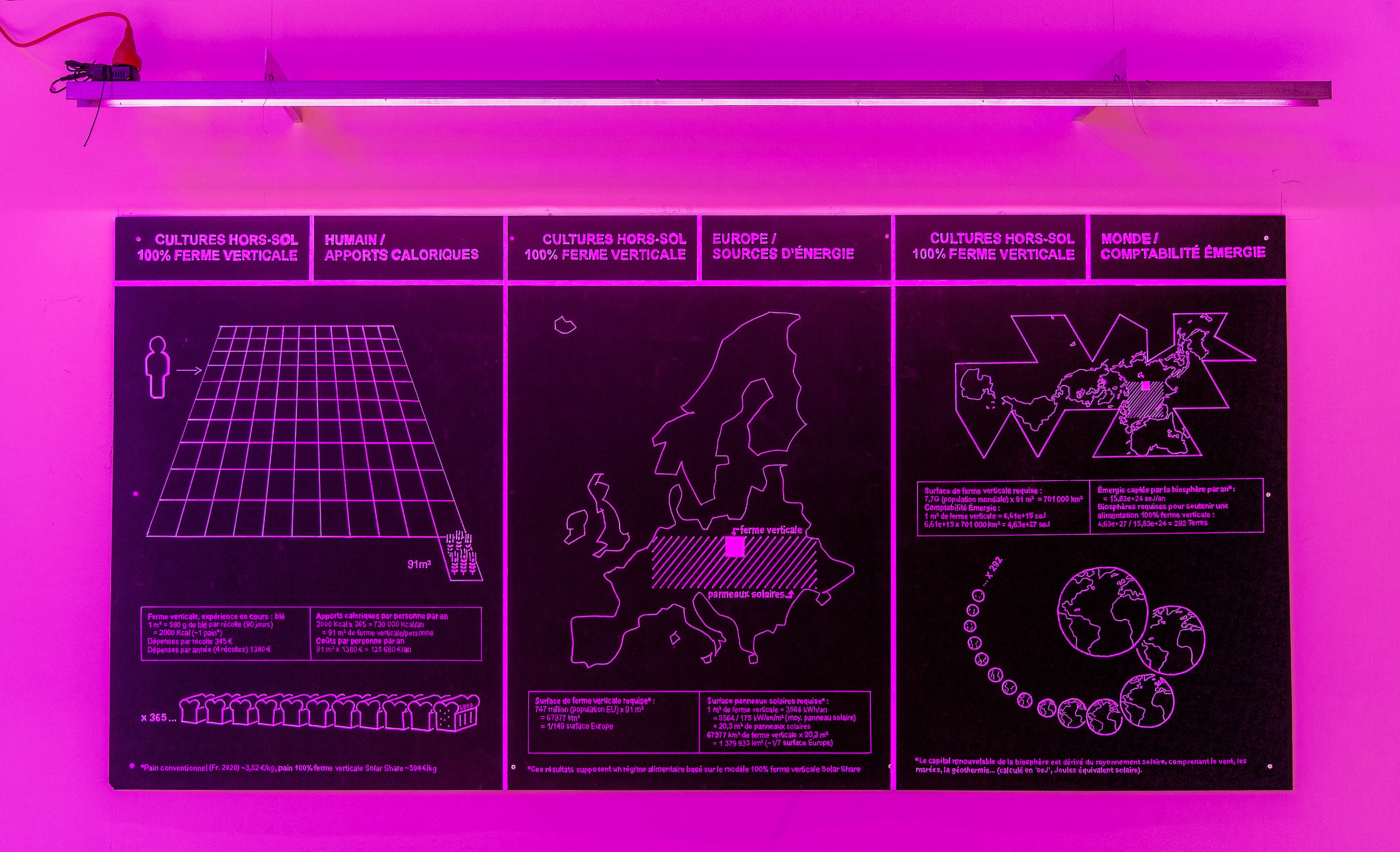
The cost calculation does include the price of the equipment (1,227 euros). The lifespan of the infrastructure is estimated at 8 years. Converted, the production of 1 m2 of wheat in an artificial environment costs 610 euros per square meter per year (including infrastructure, electricity, and water). Of this, 412 euros goes to electricity consumption and only 1 euro to water consumption. This calculation may be an overestimate because the installation is set up in an exhibition space.
The “farm” produces four harvests per year. With every harvest, enough wheat is grown to make one loaf of bread (580 grams), which has a cost of at least 345 euros. Each loaf contains 2,000 kilocalories, the amount that an average person needs per day. As a result, 91 m2 of artificially produced wheat is necessary for each person, with a total cost of 125,680 euros per year.
The paradox of vertical farming
Artificial lighting saves land because plants can be grown above each other, but if the electricity for the lighting comes from solar panels, then the savings are canceled out by the land required to install the solar panels. The vertical farm is a paradox unless fossil fuels provide the energy. 2 In that case, there’s not much sustainable about it.
Calculated at a yield of 175 kilowatt-hours per square meter of solar panel per year, the indoor cultivation of 1 m2 of wheat requires 20 m2 of solar panels. This is a underestimate because the calculations are based on the average yield of a solar panel. There is much less sunlight in winter than in summer. In reality, the vertical farm requires many more solar panels to keep operating all year round. There is also a need for an energy storage infrastructure, which costs money and energy too. Finally, solar panels' production also requires energy, which would demand even more space if the production process itself were to run on solar panels.
Innovation?
All this criticism also applies to vertical farms where lettuce and tomatoes are grown. In this case, there is a significant reduction in water use. These companies are profitable, but only because the process relies on a supply of cheap fossil fuels. If solar panels supplied the energy, the extra costs and space for the energy supply would again cancel out the savings in terms of space and costs. The only advantage of a vertical farm would then be the shorter transport distances. Still, we could just as well make transport between town and countryside more sustainable.
The problem with agriculture is not that it happens in the countryside. The problem is that it relies heavily on fossil fuels. The vertical farm is not the solution since it replaces, once again, the free and renewable energy from the sun with expensive technology that is dependent on fossil fuels (LED lamps + computers + concrete buildings + solar panels). Our lifestyle is becoming less and less sustainable, increasingly dependent on raw materials, infrastructure, machines, and fossil energy. Unfortunately, this also applies to almost all technology that we nowadays label sustainable.
Kris De Decker
More info: Solar Share (The Farm), by Disnovation.org (Maria Roszkowska, Nicolas Maigret) and Baruch Gottlieb.
Proofreading: Eric Wagner
- Subscribe to our newsletter
- Support Low-tech Magazine via Paypal or Patreon.
- Buy the printed website.
- Read more about the solar powered website.
Comments
To make a comment, please send an e-mail to solar (at) lowtechmagazine (dot) com. Your e-mail address is not used for other purposes, and will be deleted after the comment is published. If you don't want your real name to be published, sign the e-mail with the name you want to appear.
Hammer
You are ignoring nuclear energy, in which case a vertical farm is both space saving and sustainable.
kris de decker
Depends on your definition of sustainability, but yes, those two are more compatible.
Wind power would also work better than solar panels.
Rob Lee
Wow I didn't know solar panels were the only way to produce electricity for vertical farming! I sure am stumped at finding out what other methods exist to produce electricity that doesn't involve on-site power production through solar panels. I hope someone invents something soon.
Zaphod
This oversimplifies the issue a bit, but most of the energy in the solar system is nuclear energy, unless I seriously misunderstand stars.
I've never understood the big problem with earth based reactors. Sure nuclear disasters are bad news, but when you put them up against all the other industrial pollutants that get leached into environments from petrochemicals, I'm way more willing to take the risk.
If we had spent the last 30 years using our technological prowess to build safer and better traditional reactors, the world would be a much better place.
Cortop
It looks like a static analysis ignoring the fact that solar power efficiency is increasing every year.
If those companies are already profitable now by innovating, they will be ready to scale when we will need them the most.
Edmond
This criticism relies upon the false dichotomy of power coming from either solar or fossil fuels. Wind, tidal, or even nuclear avoids that issue. Furthermore even if powered with solar panels those panels do not need to be placed on fertile farmland, so there need not be a substitution.
Pertaining to the selection of crops, vertical farming does not need to grow every crop to be valuable. Farmland currently growing tomatoes or cucumbers could be switched to growing grains as those fruits are grown in vertical farms. Vertical farming would allow growing more grains and legumes on cropland currently devoted to cucumbers and peppers, significantly increasing the amount of land available for staple crops even if staple crops cannot currently be grown in vertical farms.
Distance is not the only consideration in transportation. Bulk goods like grains are not as perishable as cucumbers - logistics becomes much simpler when costly refrigeration and rapid transport is no longer a significant concern. If delicate perishables are grown in cities while only shelf-stable bulk goods are shipped in then the savings goes far beyond simple distance.
On a more speculative note, I would not expect staple crops to ever be grown in cities even in vertical farms. If bulk food production needs to be shifted into urban areas it would likely be in the use of large bioreactors for nutrient production while crops in vertical farms will still only be high-value fruits and herbs.
Brian Horakh
Wheat has a horrible photosynthetic utilization rate compared to other crops, it is only comercially viable with free energy. Potatoes can be grown indoors successfully.
tk
People don't seem te be aware that nuclear energy is much more expensive then fossil and solar.
Benjamin
Once the initial capital costs paid they will be amortized out over thousands of cycles. The costs that mater are the inputs of power and mineral.
Hydroponics excels at leafy greens. I have grown lettuces in a tower using led grow lights, 10 gallon mixing tubs, blue dow insulation, netpots, master blend, CaCO3, and epsom salt, grow plugs and net pots. (If I followed BA Kratky's method with even less). The output in leafy greens has paid for itself in less than a year when comparing it to Aldi's lettuce.
The reason why we continue to grow greens this way is because of pest pressure and the limited growing season. It allows us a continual supply of nutrients not calories. Microgreens are also economical to grow this way. I am considering making something akin to the FarmTek fodder system 3.0 (They have an excellent manual.) which only requires water and heat (solar, compost, animal BTU) To convert barley into a more effective feed.
I don't think that wheat is a good representation of vertical farms. It is an interesting experiment all the same. But the costing and longevity is poorly calculated.
Ginny Newsom
The author does not take into account areas where the growing season is very short, land is not arable and so may be put to better use with solar panels etc. The article is basically a jumping off point to compare net productivity gain with the least energy inputs. Otherwise ... what's really the point?
taco
this is insanely stupid.
Nobody thought that vertical farming would save space INCLUDING the energy infrastructure. But if you want to make a lot of food on the north pole, HOW ELSE DO YOU DO IT.
Meaning, vertical farming is already choosing a tradeoff. You are criticizing the tradeoff without even realizing it, thus coming off as insanely stupid.
Thomas M Idzikowski
What an incredibly stupid "hit"piece. Do more research before embarrassing yourselves.
Jack
Solar panels could be on rooftops, or at sea or lakes/reservoirs.
And where land is used, what kind of land? Solar can be put on barren and desert land, leaving fertile soils to revert to forest/prarie, etc.
Plus of course there's wind, nuclear, geothermal.
And vertical farming isn't just about land size, but also efficiency, transport, freshness, and so on.
Yanis
First of all - that light source seems way too much for 1m2. Vertical farms use small LEDs not this stellar monstrosity.
Also, plants do not need whole spectrum, but only part of it - and if insects are not used during pollination period, then there is even less spectrum needed overall and electricity needed to produce that part of light - the Great saving here is only with specialized light sources.
If we take into account these power estimates, then costs for growing wheat are at least 1000x less than what is calculated there. Wheat is interesting choice(as vertical farms are build to grow tomatoes or other greenhouse crops), but there are plenty of expensive plants that can be grown this way to save expensive travel costs. Heck, even grapes can be grown this way, because it is not a necessity, but for luxurious consumption and Vertical Wine will sure have niche.
As for water - it is kinda dumb, that all those 347 liters of water went straight to waste. There sure must be a way, to reuse that water again and again - even making crop growing as half of a side product, while growing fish with aquaponics as other product.
There is also one very huge advantage of indoor growing over fields, that is not in topics yet - pumping in those rooms some extra CO2, where plants will thrive and produce even more output - I suppose even much bigger fruits than we are used to and also side effect of CO2 is local global warming, so no extra warming needed.
The problem of outdoor growing is that there are still many disasters happening - if there is too much rain, then there are floods happening, if there is not enough rain, that is damaging as well - just like too much/less sun. Too warm winter leads to more insects, that you have to battle with god ol pesticides and you need lots of them(and they kill bees), then there are wild pigs as well, which you can't shoot, but they can plow through your fields like tractors and in warmer countries there are swarms of locusts.
Farmer costs / vertical farm costs land tax / same tax for larger space paying for pesticides / insects have no easy access human workforce / automation
Huge advantage over farmers, is that vertical farms operate as warehouses, while farms has to immediately ship produce, that was gathered on field. Also verical farms can produce during winter, bad season etc. which in the end means, that their product will have constant price/and income all year. farmers have to operate in cycles of constant expenses while preparing crop and income is only when crop is sold(usually once per season).
James Simpson
This is a thoughtful and provocative article which has male, pro-capitalist, technophile readers fuming with rage. Obviously, solar is not the only technology which is classed as renewable to supply vertical farming. But every energy source is dirty in different respects and fossil fuels had the huge advantage of being more energy-dense than pretty much all alternatives. Why else did our 19th-century ancestors abandon wind power in favour of coal and then oil?
Solar farms might not take up land currently used for growing humans' food but it is used for other purposes, including habitats for other forms of life which are largely excluded from it. This technology relies on extractive, polluting industrial systems, if not so much as any fossil fuel, and is not really sustainable.
Gaia Baracetti
So many aggressive comments!
Maybe what's "stupid" is wanting tomatoes in Northern Europe in the winter... Taco: look at the Saapmi. They've figured out a way to feed themselves in the Artic sustainably while developing a rich culture and coexisting with a beautiful wilderness.
Even if vertical farming on a large scale was "efficient"... who would want to live in a world of skyskrapers and shade, working indoors all the time, with no fields and orchards and meadows? And what do you all mean by "barren" land, don't you know that there are species inhabiting every niche on Earth, and by paving it with panels or what have you we would destroy their only home?
Is that what all our life comes down to now, efficiency and convenience?
kris de decker
Author here. I had no idea that vertical farms were such an emotional topic. Also lots of comments at hackernews: https://news.ycombinator.com/item?id=26184355
I hope it is clear that this article is not meant to stop people from growing some lettuce in their city flat. There's nothing wrong with that. This article (and this art work) criticizes the idea that vertical farming could supply a substantial share of a city's food supply.
There's a simple reason why I focus on solar energy: it's what the art work does. Nevertheless, I should have added a paragraph on other energy sources.
In combination with atomic energy, a vertical farm would indeed save a lot of space. Nuclear power has the highest power density of all energy sources. As long as everything goes well, that is, cause when a nuclear power plant melts down, it suddenly becomes the power source with the lowest energy density on earth. I don't want to start a discussion about atomic power here, but I have never heard the proponents of vertical farms say that their idea only works with a nuclear power plant.
I am surprised nobody talks about wind turbines. They combine much better with vertical farms, because the wind blows horizontally, not vertically. Biomass has the same drawbacks as solar panels.
Many people have argued that the solar panels could be located on land that is not suited for agriculture. Deserts are often mentioned. However, it's perfectly possible to farm in deserts. Second, a solar farm is detrimental to desert ecosystems. A desert is more than sand. And of course that goes for all land not suited for agriculture. If you cover it with a solar farm, you destroy much of the natural value that the land has. Again, wind does much better. Also, unless your city is next to a desert, this idea involves transporting electricity over long distances, which comes with its own problems and inefficiencies.
Some have argued that solar panels can be used vertically. Yes, they can. But vertically placed panels only supply a fraction of energy compared to horizontal panels. You may save space, but you need much more resources to build the power infrastructure.
Someone writes this above: "Also vertical farms can produce during winter, bad season etc. which in the end means, that their product will have constant price/and income all year."
--> Yes, but do you also realize that solar panels produce much less power in winter? In the Netherlands, they produce on average 10 times less in winter than in summer. In Spain, the difference is a factor of four. So, if you want your vertical farm to produce as much in winter as in summer, you will need 4-10 more land for the solar panels.
"First of all - that light source seems way too much for 1m2. Vertical farms use small LEDs not this stellar monstrosity."
--> Wheat needs more light than lettuce. So you need more powerful lighting.